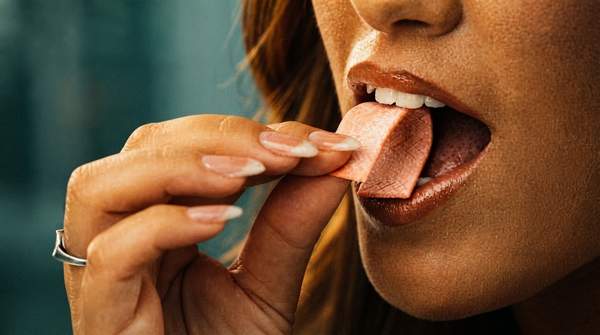
Chewing gum flavor is a race against chemistry. As you chew, sweeteners and flavor compounds dissolve in your saliva and wash over your tongue, and once they are gone, they are gone. Gum makers fight that fade with two main engineering levers: the chemical properties of the gum base itself, which control how quickly flavor diffuses out, and encapsulation technology, which traps ingredients behind barriers that chewing breaks open over time. Understanding those two levers explains why one gum's taste evaporates in minutes while another keeps delivering small bursts of sweetness deep into a long chew.
The Challenge of Lasting Flavor in Chewing Gum
The core problem is solubility. As the American Chemical Society's chemistry education materials explain, sweeteners and flavorings dissolve in saliva as you chew and spread over your tongue. That dissolution is exactly what you taste — and exactly what ends the flavor. A highly water-soluble ingredient like a high-intensity sweetener releases almost immediately, because nothing in the gum holds it back.
That leaves manufacturers with two broad strategies. They can choose a gum base whose physical structure slows the escape of flavor compounds, or they can wrap those compounds in protective particles that release them on a schedule. Most modern gum uses both, which is why a single piece can deliver an initial punch, a steady middle, and late bursts of sweetness.
Gum Base Properties: Natural vs. Synthetic Flavor Release
In conventional synthetic gum, the base does the flavor-holding work. The base is hydrophobic — it repels water, which is why it never dissolves in your mouth. That same water-repelling property binds synthetic flavor compounds and releases them gradually through diffusion as you chew, producing the sustained, consistent flavor that eventually disappears completely.
The structure responsible for that slow release is polymeric. Gum bases are built from three ingredient families — resin as the main chewable body, wax to soften, and elastomer to add flexibility — and the base often contains polyethylene, the same long molecule used to make plastic bottles and bags. Those long molecules form a matrix that flavor must work its way out of.
Natural gum takes the opposite approach. Writing for Nathan & Sons, Nate Mal describes a natural product whose flavor "doesn't start with a flavoring department" but with the base itself, using tree saps such as chicle, mastic, and spruce. Because the flavor is inherent to the base rather than added on top of it, the release profile is fundamentally different — the flavor comes through quickly rather than diffusing slowly out of a polymer matrix.