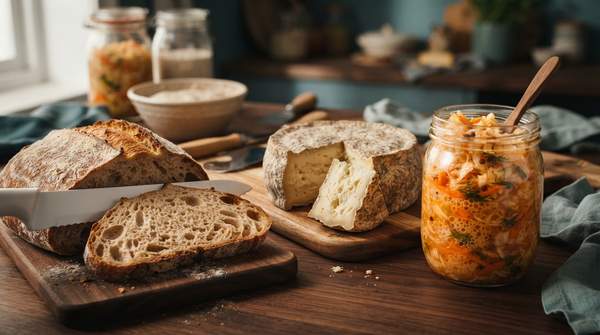
A year-long experiment on Cheddar-making, meticulously tracking microbial populations, revealed that removing a single starter culture member like Streptococcus thermophilus caused other essential bacteria to decline much more steeply than expected, according to Nature. Unexpected microbial fragility highlights the intricate interactions governing artisan cheese flavors, demonstrating how a minor alteration can destabilize an entire fermentation system. While artisan cheese flavor is traditionally seen as an art guided by intuition, high-throughput scientific approaches are now systematically uncovering the precise microbial mechanisms behind these complex organoleptic properties. The systematic uncovering of precise microbial mechanisms creates a fundamental tension between romanticized craft and emerging data-driven microbial control. The future of artisan cheesemaking will increasingly blend traditional craft with scientific precision, leading to a new era of controlled innovation and potentially novel flavor profiles.
Understanding Microbial Roles in Artisan Cheese
The complex microbial interactions within cheese microbiota significantly influence its rheology, organoleptic properties, and safety, according to Microbial Interactions within the Cheese Ecosystem and Their... - PMC. These microscopic communities dictate how a cheese develops its characteristic texture, aroma, and taste over weeks or months. Understanding these mechanistic details is crucial for predicting fermentation success and diagnosing technological failures. The diverse microbial ecosystem in artisan cheese is therefore fundamental to its characteristics, extending far beyond simple fermentation, and its intricate details are key to both success and failure.
Advanced Science Unlocks Cheese Flavor Secrets
High-throughput DNA sequencing, including amplicon and whole-metagenome shotgun sequencing, now enables accurate identification and study of the cheese microbiome's potential functionality, according to Omics Approaches to Assess Flavor Development in Cheese - PMC. Researchers also employ an integrative systems biology approach, combining genomics, genome-scale metabolic modeling, metatranscriptomics, and metabolomics, to investigate microbial interactions in cheese flavor formation, as reported by Nature. These combined strategies allow scientists to map microbial genetic potential to actual activities and resulting flavor compounds. Systematic investigation transforms the 'black box' of cheese ripening into a predictable system, enabling the diagnosis of failures and the prediction of fermentation success, a capability previously reliant on trial-and-error.
The Delicate Balance: When Microbes Go Rogue
Non-starter lactic acid bacteria (NSLAB) significantly contribute to cheese flavor, texture, and nutritional value, but they can also cause quality defects and off-flavors, according to Omics Approaches to Assess Flavor Development in Cheese - PMC. The dual role of non-starter lactic acid bacteria highlights the challenge of managing complex microbial communities. A year-long Cheddar-making experiment illustrated this complexity, utilizing four variations of starter cultures, including one excluding Streptococcus thermophilus (ST), as detailed by Nature. This study found that in starter cultures containing S. thermophilus, lactococci and S. thermophilus populations declined slowly, maintaining a more stable microbial environment. However, without S. thermophilus, the lactococci population declined much more steeply, indicating a critical symbiotic relationship. The discovery means cheesemakers can no longer view starter cultures as simple ingredients but as complex, interacting ecosystems requiring precise management to avoid unforeseen quality defects.
Engineering Consistent Artisan Flavors
Companies shipping artisan cheese without leveraging meta-omics for microbial control operate with significant blind spots, risking inconsistent quality and flavor profiles. The ability to accurately identify and study the entire cheese microbiome's functionality, including its contribution to organoleptic properties, means cheesemakers can move beyond traditional recipes. The ability to accurately identify and study the entire cheese microbiome's functionality allows precise selection and management of microbial consortia for targeted flavor profiles and consistent quality, ensuring a more reliable consumer experience. Precise selection and management of microbial consortia provides a blueprint for flavor, rather than a reliance on a 'black box' process. The traditional notion of a 'master cheesemaker' is rapidly evolving; future success will hinge not just on intuition, but on the ability to interpret complex microbial data to diagnose fermentation failures and proactively design specific flavor outcomes. The shift towards interpreting complex microbial data requires integrating advanced analytical tools and computational models into daily production, moving cheesemaking closer to a controlled scientific process.
Can specific bacteria strains enhance cheese flavor profiles?
Yes, specific bacteria strains can significantly enhance and direct cheese flavor profiles by producing unique enzymatic activities. For example, certain strains of Lactobacillus helveticus are known to contribute to nutty and sweet notes through specific proteolytic pathways, breaking down milk proteins into flavor peptides. This targeted approach allows cheesemakers to cultivate distinct and consistent aromatic characteristics in their products, moving beyond general fermentation. Such precise control over microbial activity facilitates the development of novel flavor combinations.
What are the key microbial communities in cheese production?
Key microbial communities in cheese production generally include starter cultures, primarily lactic acid bacteria like lactococci and streptococci, which initiate acidification. Beyond these, non-starter lactic acid bacteria (NSLAB) such as various Lactobacillus species, along with yeasts and molds, play vital roles in ripening. For instance, Brevibacterium linens is crucial for the development of pungent, earthy flavors and reddish-orange rinds in washed-rind cheeses. These diverse groups interact to form the complex ecosystem responsible for a cheese's final characteristics.
How do microbes affect cheese flavor?
Microbes affect cheese flavor through a variety of complex biochemical processes during ripening, primarily through enzymatic reactions. These include proteolysis, where proteins are broken down into amino acids and peptides that contribute savory notes, and lipolysis, which breaks down fats into fatty acids influencing buttery or tangy flavors. Additionally, microbial metabolism produces volatile compounds like diacetyl for buttery notes or sulfur compounds for pungent aromas, all contributing to the distinct sensory profile of a cheese.
By 2026, cheesemakers who integrate meta-omics technologies, like those pioneered by research institutions such as Cornell University's Food Science department, will likely hold a distinct advantage in optimizing flavor profiles and textures through predictive models.