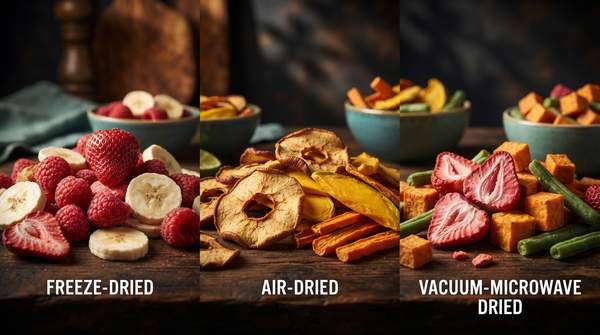
Freeze-drying and vacuum-microwave drying preserve nutrients and texture far better than traditional air-drying, but they trade that quality against cost and complexity. Freeze-drying is the benchmark for premium quality, retaining roughly 90–97% of nutrients, while air-drying is the cheapest option and produces the familiar chewy, leathery snack at the price of greater nutrient loss. Vacuum-microwave drying sits in between, matching freeze-drying's nutrient retention in a fraction of the time. Here is how each method works, why the outcomes differ, and how to pick a product that matches your priorities.
Freeze-Drying: Preserving Quality Through Sublimation
Freeze-drying works by freezing the food solid and then applying a vacuum so that the ice converts directly to vapor—sublimation—without ever passing through a liquid phase. Because the water leaves as a gas from within a frozen matrix, there is no liquid water to collapse or rupture cell walls. The result is a light, porous product that keeps its original shape, color, and much of its flavor, and that rehydrates quickly toward its original form.
Nutritionally, the process is hard to beat. A review of freeze-drying of plant-based foods notes that vitamin C is typically used as a reference index of nutrient quality because it is more labile than most other nutrients—if ascorbic acid survives well, other nutrients likely do too. The same review concludes that freeze-drying, thanks to its lack of liquid water, oxygen-free vacuum environment, and low operating temperatures, is the best choice for dehydrating fruits and vegetables while keeping an optimized biocompound content. Commercial and technical sources converge on a 90–97% nutrient retention figure.
The catch is efficiency. EnWave, a drying-technology company, describes freeze-drying as slow—typically 24 to 48 hours—and energy-intensive, requiring specialized machinery. A scientific review of drying techniques likewise found freeze-drying delivered the longest drying times and highest energy consumption in head-to-head studies, even while achieving the best retention. Some foods can also come out powdery or mushy, and flavor can occasionally fall flat.