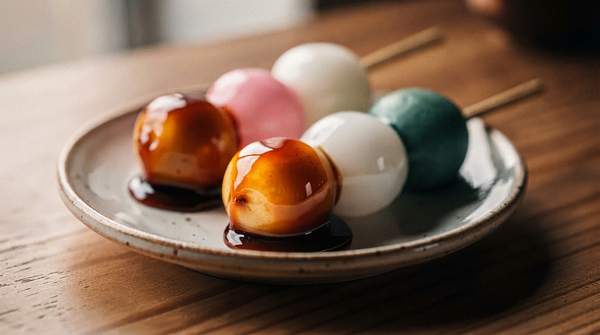
Mochi is a chewy Japanese rice cake made from glutinous rice that is steamed, pounded, and molded into soft cakes, and its many descendants can be told apart with three simple questions: what is it made from, does it hide a filling, and when do people eat it? Daifuku is mochi wrapped around sweet red bean paste; dango is a skewered rice-flour dumpling with no filling at all; and mochi ice cream is a modern fusion that tucks a ball of ice cream inside the mochi skin itself. Understanding those distinctions is easier once you know where mochi came from, because its journey from ritual food to everyday confection explains why so many different things now travel under its name.
From Ancient Grains to Imperial Delicacy: Mochi's History
Mochi's story in Japan stretches back well over a thousand years, and its earliest chapters are tied to ceremony rather than snacking. According to archaeological research summarized in the encyclopedic record of mochi, homemade production of the rice cake increased beginning in the 6th century, during the Kofun period, when earthenware steamers became popular in households, mainly in eastern Japan. By the late 8th century, in the Nara period, a legend concerning mochi was already being recorded in the Bungo no kuni fudoki, a regional chronicle—evidence that the food had woven itself into the cultural imagination early.
Reporting on mochi's Chinese origins notes that the rice cake was introduced to Japan from China and subsequently used in imperial and religious ceremonies during the Heian and Muromachi periods. Over time, mochi evolved from a ritual food into a popular treat enjoyed by people of all ages, and it became a symbol of prosperity and good fortune in Japanese culture. That symbolic weight still shows up on the table: mochi is a key ingredient in ozoni, a New Year's soup, and it was originally a staple food during the Japanese New Year and used in various traditional ceremonies.
Diverse Delights: Exploring Mochi Varieties
The traditional craft behind mochi is labor-intensive by design. The primary ingredient is glutinous rice—mochigome—whose higher starch content, compared with regular rice, gives mochi its signature chewiness. The rice is steamed, pounded, and molded into soft, chewy cakes; in the traditional ceremony known as mochitsuki, that pounding is done with a wooden mallet in a large mortar, with the steamed rice worked repeatedly until it becomes a single smooth, elastic mass. Sugar or other sweeteners are often added afterward to enhance flavor, but the transformation itself is entirely mechanical: heat, muscle, and starch.
From that plain pounded base, Japanese confectioners—makers of wagashi, the family of traditional Japanese sweets—built an entire repertoire. Because historical Japanese sweets drew on a shared flavor palette of sweet azuki beans, sesame, and chestnut, many mochi-based wagashi revolve around those same ingredients, and some confectionery shops across the country still employ historical production methods. Notable mochi-based wagashi include sakura mochi, daifuku, and mochi ice cream, each playing its own role in the longer history of mochi in Japan. Dango, meanwhile, occupies a related but distinct branch of the rice-dumpling family, one so familiar that it appears in the famous folktale of Momotaro, the boy born from a peach.
Comparing Key Mochi Varieties
The fastest way to stop confusing these treats is to line them up side by side. The table below contrasts three of the most commonly mixed-up varieties across their core attributes—what they are, what goes into them, where they came from, and how they are typically enjoyed.
| Type | Key Ingredients | Historical Context / Origin | Typical Use |
|---|---|---|---|
| Daifuku | Glutinous rice mochi shell enclosing a sweet filling, typically red bean paste; the ichigo daifuku version contains a whole strawberry | A traditional mochi-based wagashi; when made with kusa mochi, mochi flavored with mugwort (yomogi), it is called yomogi daifuku | Eaten as a sweet confection or dessert, a popular treat in Japanese culture |
| Dango | Rice flour, giving a chewy texture; no filling | A long-standing presence in Japanese folklore, appearing in the tale of Momotaro | Served as skewered dumplings on sticks, highlighting the simplicity of rice flour |
| Mochi Ice Cream | Small balls of ice cream wrapped inside a mochi covering | A contemporary fusion treat; in Japan it is manufactured by the conglomerate Lotte under the name Yukimi Daifuku, "snow-viewing daifuku" | Eaten as a modern dessert or snack, enjoyed straight from the freezer |
The pattern that emerges is one of increasing elaboration and, eventually, modernization. Plain mochi is the blank canvas—pounded glutinous rice molded into round or square shapes, awaiting flavors and fillings. Daifuku takes mochi further by artfully enfolding sweet fillings, transforming a simple rice cake into a satisfying confection. Dango moves sideways rather than upward: it typically manifests as rice-flour dumplings skewered on sticks, and unlike daifuku, which encapsulates sweet fillings within a mochi shell, dango highlights the simplicity of rice flour itself. Mochi ice cream then swaps the traditional filling for ice cream entirely, keeping the chewy wrapper but reinventing what sits inside it.
Mochi's Global Journey and Modern Adaptations
Mochi's evolution did not stop at daifuku. Modern variations have carried the chewy texture of pounded and molded rice into formats its ritual-era makers would never have recognized. Beyond mochi ice cream, contemporary adaptations include mochi donuts, a fusion treat combining mochi's chewiness with the sweetness of donuts, and mochi bread, a savory variant made with mochi rice and other ingredients to create a chewy loaf. Mochi also appears in savory and comforting preparations: pieces of it are added to oshiruko or ozenzai, a sweet azuki bean soup that Japanese people often eat in winter to warm themselves.
What unites these offshoots is the underlying ingredient and technique. Whether the mochi is wrapped around ice cream, dropped into soup, or served plain with a bit of soy sauce or sugar, the glutinous rice base—steamed, pounded, and molded—remains the defining feature, and it is precisely that texture, unfamiliar to many Western palates, that has become mochi's calling card on the global snack shelf. The same quality that once made mochi a ceremonial food in the Heian and Muromachi periods now makes it a sought-after novelty in supermarkets far beyond Japan.
Appreciating Mochi's Cultural Depth
To fully appreciate mochi, consider its historical journey from a ritualistic food to a diverse culinary art form, understanding that each variation carries its own unique cultural significance and preparation. A rice cake that began as a ceremonial offering, spread through households as earthenware steamers became commonplace, and later filled the shelves of confectionery shops has never stopped adapting—yet every adaptation, from skewered dango to freezer-aisle mochi ice cream, still traces back to the same pounded glutinous rice.
The practical payoff of that history is simple to test: the reader can distinguish between Daifuku, Dango, and Mochi Ice Cream based on their ingredients, historical context, and typical use, recognizing their distinct roles in Japanese culture. Next time you face a mochi counter, run the three questions—filling or none, rice flour or pounded rice, traditional wagashi or modern fusion—and the answer will be on the tip of your chopsticks.
Sources
- Mochi - Wikipedia — EN
- Daifuku: Traditional Japanese Sweets That Have Endured & Evolved — Japanese Taste
- Mochi History: Trivia, Facts & How to Make It! - Sakuraco — Sakuraco | Japanese Snacks & Candy Subscription Box
- The Ultimate Guide to Mochi: Everything You Need to Know - Ying Xuan Zhuang