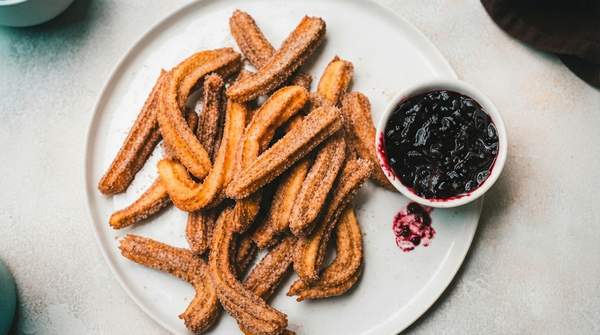
Nobody invented the churro—or at least, nobody we can name. Food historians trace the beloved fried stick through at least four competing origin stories: an ancient Roman fritter, a Moorish syrup-soaked pastry, a Chinese breakfast dough carried home by Portuguese sailors, and a practical mountain snack made by Spanish shepherds. What is clear is that the churro split into distinct traditions as it traveled, and the differences are easy to spot once you know them.
The Debated Origins of the Churro: A Culinary Mystery
Ask where churros come from and you will get confident, contradictory answers. The origin is genuinely unclear, and even the name is contested: the Diccionario de la lengua española treats "churro" as onomatopoeic, imitative of the sound of frying, while other accounts link it to the horns of the churra sheep breed. Rather than one tidy story, the evidence points to a family of fried-dough traditions that converged in Spain and then scattered across the globe through colonization and trade. Each theory below has real documentary support—and real weaknesses.
Ancient Roots: Roman Fritters and Moorish 'Zalabia'
The deepest claim comes from food historian Michael Krondl, who argues that "today's churro is not that different from a recipe for a flour and water fritter that you find in Apicius, a Roman cookbook dating from the 1st century AD." He adds that similar recipes exist from the ancient Greeks and that in the Mediterranean basin, fried dough "basically been around forever."
The Moorish thread is more specific. Some in Spain credit the Moors with bringing a dish called tueles to Spanish territories, where local cooks added their own elements like sugar and chocolate. Preserved cookbooks from Spain's Islamic period include instructions for making al-Zalábiyya—wheat dough pressed through a circular hole and dropped into hot oil—which the Detroit Institute of Arts describes as "the first ancestor of the Spanish churro." The earliest known recipes for the related zalabiyeh appear in the 10th-century Arabic cookbook Kitab al-Tabikh, which offered both plain and latticed versions made from a semi-thin wheat batter poured into hot oil. Traditional serving followed the syrup route: modern cooks of zalabia still describe simple sugar syrup as the classic finish.
The East-West Connection: Chinese 'Youtiao' and Portuguese Traders
A very different theory points east. Youtiao, a salty fried pastry from China, has been proposed as the churro's predecessor—a dough with no chocolate or cinnamon pairing, traditionally served with rice congee or soy milk. The mechanism would have been Portuguese sailors, who sailed to the Orient and, returning from Ming-dynasty China, brought new culinary techniques back to Iberia. It is worth noting that some consider this account a hoax, so treat it as one plausible thread rather than settled history. What it does show is that fried dough traditions arose independently across cultures, making a single lineage hard to prove.
Spanish Shepherds: A Practical Origin Story
The most popular tale is the most charming: Spanish shepherds, spending most of their time in the mountains with no ovens, made churro paste because it was easy to prepare and fry over an open fire, substituting for fresh baked goods. The name, in this telling, came from the twisted horns of the Navajo-Churro sheep breed. But the story has a practical problem: the shepherds' nomadic lifestyle and the large quantities of oil or fat that frying demands make this account unlikely in the eyes of some historians. From the mountains, churros moved into Spanish cities as common street food, sold by vendors at fairs and festivals.
Regional Churro Variations: A Comparative Guide
Once churros crossed the Atlantic—particularly to Mexico, where they were embraced and adapted into local cuisines—they began to diverge in shape, coating, and accompaniment. The table below contrasts the documented styles so you can tell them apart at a glance.
| Region | Typical Accompaniment | Common Characteristics |
|---|---|---|
| Spain | Thick, rich hot chocolate or café con leche for dipping | Long and twisted, often served straight; typically dusted with sugar and cinnamon; a breakfast food |
| Mexico | Hot chocolate or coffee for dipping | Coated in cinnamon-sugar; frequently filled with ingredients such as cajeta or dulce de leche; sold by street vendors and churrerías at fairs and festivals |
The pattern to notice: Spain keeps the churro plain and leans on the dip, while Mexico builds the indulgence into the pastry itself with coatings and fillings.
Traditional Spanish Churros: Simplicity and Dipping
In Spain, the churro is fundamentally a breakfast pastry, and its identity lives in the cup beside it. The traditional form is long and twisted, served straight, with a thick, rich hot chocolate designed for dipping the crisp exterior into something nearly pudding-dense; café con leche is the everyday alternative. Regional variation exists—some areas make them thinner, some thicker—but the sugar-and-cinnamon dusting and the dunking ritual remain constant. It is a study in restraint: the pastry provides texture, the chocolate provides the luxury.
Latin American Adaptations: Fillings, Coatings, and New Forms
Mexico took the template and ran with it. Street vendors and dedicated churro shops serve churros with a variety of toppings and fillings, and they are a fixture at fairs and festivals rather than a morning ritual. The cinnamon-sugar coating is standard, and fillings like cajeta (goat's milk caramel) and dulce de leche turn the churro into a self-contained dessert. Elsewhere in Latin America, dulce de leche appears as a companion rather than a filling. The tradition keeps evolving, too: contemporary vendors offer churro bowls, new fillings, and novelties like churro ice cream sandwiches, which press a scoop of ice cream between churro slices for a warm-cold contrast.
Understanding the Churro's Global Journey
The honest conclusion is that the churro's history is a rich tapestry of culinary influences, not a single origin story: a Roman-era fritter tradition, a documented Moorish al-Zalábiyya, a possible Chinese-Portuguese route, and a beloved if improbable shepherd's tale all feed into it. The practical payoff is simple: the reader can identify the key characteristics of a Spanish churro versus a Mexican churro when encountering them in different contexts. Next time you face a tray of them, check the evidence—straight and dunked in thick chocolate points to Spain; cinnamon-sugar coating and a cajeta filling points to Mexico.
Sources
- Churro - Wikipedia — EN
- The Origin Of Churros: Brought by the Moors — History Cooperative
- Churros, Culture and Connection: Celebrating Our Shared Humanity through Food — DIA
- Zalabiyeh - Wikipedia — EN
- Zalabia Recipe — Palestine In A Dish