Nobody knows for certain where the churro comes from, and that uncertainty is precisely what makes its history worth telling. Food historian Michael Krondl argues the pastry may descend from a flour-and-water fritter recorded in Apicius, a Roman cookbook from the first century AD, which would make the churro's lineage nearly two millennia old. A second theory credits Portuguese merchants with adapting the Chinese fried dough youtiao, while a third holds that Spanish shepherds invented the ridged pastry out of practical necessity. What is not disputed is what happened next: the churro became a breakfast staple in Spain, a filled street-food icon in Mexico, and a globally reinterpreted dessert, and each stop on that journey changed the pastry.
The Debated Origins of the Churro: Three Competing Theories
Popular accounts usually reduce the churro's birth to a tidy "China versus Spain" argument, but the documentary record is murkier and more interesting. The origin of churros is, by consensus, unclear—and the word itself offers no help, since the Diccionario de la lengua española treats "churro" as onomatopoeic, imitative of the sound of frying. What culinary historians offer instead are three distinct narratives: an ancient Mediterranean fritter tradition, a Chinese pastry carried west by traders, and an independent shepherd's invention in the mountains of Spain. Each theory rests on a different kind of evidence, and none has been established as definitive. The chart below sets out the three accounts side by side so the debate can be judged on its own terms.
Churro Origin Theories: A Comparative Overview
The point of the table is to separate what each theory actually claims from the loose shorthand that often accompanies it. Note the different burdens of proof: one theory appeals to a surviving ancient cookbook, one to a documented transcontinental trade in recipes, and one to practical kitchen improvisation.
| Theory | Proposed origin | Key premise |
|---|---|---|
| Ancient Mediterranean Fritter | Rome, first century AD, with Ancient Greek precedents | Today's churro closely resembles a flour-and-water fritter recipe in the Roman cookbook Apicius; in the Mediterranean basin, Krondl says, this kind of fried dough "is basically been around forever" |
| Chinese 'Youtiao' Adaptation | Southern China, carried to the Iberian Peninsula | A fried dough called youtiao (also known as yóuzháguǐ in southern China), which resembles the churro, was modified and introduced to Spain, where the dough was extruded through a star-shaped nozzle rather than pulled |
| Spanish Shepherd Invention | Mountainous regions of Spain | Shepherds created churros as a shepherd's snack, modifying a fried dough recipe for easy cooking over open fires, with the star shape aiding frying in mountainous terrain |
Theory 1: The Ancient Mediterranean Fritter Precursor
Krondl's argument is the least commonly told but historically the deepest. As he puts it, "today's churro is not that different from a recipe for a flour and water fritter that you find in Apicius, a Roman cookbook dating from the 1st century AD. And there are recipes from the Ancient Greeks, but it's probably even older than that." On this view, the churro is not an invention at all but a survival: the simplest possible pastry—flour, water, hot oil—persisting through two thousand years of Mediterranean kitchens. The theory's strength is its documentary trail into antiquity; its weakness is that it explains a category of fried dough rather than the specific ridged, star-nozzled form people recognize today. It is a theory about ancestry, not necessarily about the moment the churro took its modern shape.
Theory 2: The Chinese 'Youtiao' Adaptation
The best-known alternative points east. Youtiao, a fried dough also called yóuzháguǐ in southern China, bears a striking resemblance to the churro, and the common account holds that Portuguese merchants encountered it in China, altered the dough, and brought the result back to the Iberian Peninsula. There the recipe diverged from its model: the dough was extruded through a star-shaped nozzle—the ancestor of today's piping-bag ridges—rather than pulled by hand, giving the Spanish pastry its distinctive fluted profile and greater surface area for crispness. It is worth noting that this account, however widely repeated, rests on resemblance and trade-route plausibility rather than a firm historical document, a caution flag that should temper any confident retelling.
Theory 3: The Spanish Shepherd's Invention
The third story skips merchants and empires entirely and locates the churro's birth in the Spanish countryside, where shepherds living for long stretches in mountainous terrain needed food that required no oven and little equipment. Fried dough, cooked in oil over an open fire, fit that need perfectly—and the star-shaped extrusion, in this telling, was developed to facilitate frying in those mountain conditions. Retellings of churro history routinely describe the pastry's "humble origins as a shepherd's snack in Spain," which has made this the most emotionally satisfying of the three narratives. Like the youtiao theory, it is a plausible folk history rather than a documented one, but it explains something the Roman theory does not: why the churro looks the way it does.
Churros in Spain: A Traditional Breakfast Staple
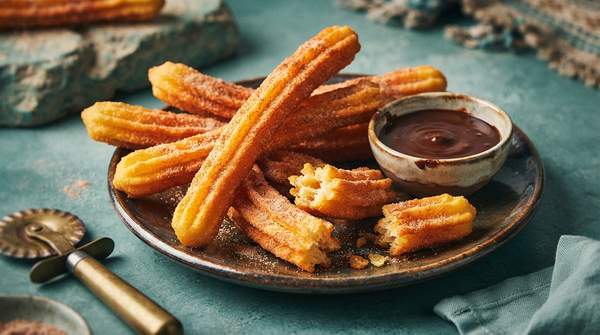
Whatever its birthplace, the churro's Spanish identity is not in dispute. In Spain, churros are a staple of the cuisine and a fixture of the morning: they are often enjoyed for breakfast, dipped into thick hot chocolate or a cup of café con leche, the dense chocolate serving as the classic partner to the crunchy, sugar-dusted sticks. Preparation is deliberately simple—dough fried until crunchy, sometimes sprinkled with sugar, and nothing more elaborate than that. The Spanish churro is, in other words, a minimalist pastry: unflavored, unfilled, and defined by the contrast between crisp exterior and soft interior, with the accompaniment doing the sweetening. Accounts also describe the Spanish churro being enjoyed as a late-night snack after a night out, doubling its role in daily Spanish eating habits.
The Mexican Evolution: From Street Food to Cultural Icon
With the expansion of Spanish influence during the age of colonization, churros found their way to Latin America, where they were embraced and adapted to local tastes—and Mexico took the adaptation furthest. Mexican churros left the breakfast table and became a popular street food, sold by street vendors and at dedicated churrerías, and a fixture at fairs and festivals, enjoyed by people of all ages. The pastry itself changed: Mexican versions are often filled with dulce de leche or cajeta and sometimes sprinkled with cinnamon sugar, a spicing and stuffing the traditional Spanish version rarely receives. Each country in the region developed its own regional variations, incorporating local flavors and ingredients, but the Mexican model—portable, filled, cinnamon-dusted—became the template most of the world now associates with the word "churro."
Modern Dessert Adaptations and Global Popularity
The most recent chapter moves the churro from street to dessert menu. Contemporary recipes range from traditional Spanish churros to creative twists like pumpkin spice or Nutella-filled versions, and the pastry has been incorporated into dessert creations such as churro ice cream sandwiches—warm, crunchy churro slices wrapped around cold ice cream—as well as churro waffles and churro milkshakes. These variations reflect global tastes and traditions rather than any single national cuisine, and their spread has made the churro a trendy dessert option for food enthusiasts and influencers. The pastry that may have begun as a shepherd's improvised snack or a Roman-era fritter has ended up as a cultural icon with significance in many countries, a food flexible enough to absorb nearly any flavor an inventive kitchen throws at it.
Understanding the Churro's Enduring Appeal
Recognize that the churro's rich and debated history, coupled with its adaptability, contributes to its global appeal and cultural significance. The pastry's very obscurity of origin is part of its power: three plausible origin stories, each tied to a different claimed homeland, mean that Spain, China, and the ancient Mediterranean can all reasonably see themselves in the ridged dough—and each tradition has, in practice, remade the churro in its own image. Readers should recognize that the evidence supports no definitive winner among the theories, and the honest answer to "who invented the churro?" is that nobody can say.
The measurable indicator to watch is the continued emergence of new regional variations and modern dessert applications of churros, from filled Mexican street versions to Nutella-stuffed and ice-cream-sandwich adaptations: as long as kitchens keep reinventing the form, the debate over its birth only adds flavor to a pastry that never stopped traveling.