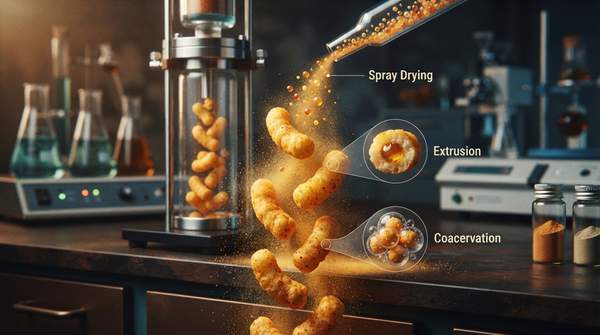
Every time a cheese puff delivers its tangy hit months after leaving the factory, an invisible piece of food engineering is at work. Flavor encapsulation—the practice of trapping flavor compounds inside a protective matrix—has become a critical technology for food and ingredient manufacturers seeking to improve flavor stability, extend shelf life, and deliver consistent sensory experiences. This article explains why the technique exists, how the major methods work, and how choices as small as particle size change what you taste.
The Science of Snack Appeal: Why Flavor Encapsulation Matters
Flavor is one of the most important factors determining the quality and acceptability of foods, and many processed foods are formulated with added flavors specifically to enhance consumer satisfaction. The catch is that flavor compounds are fragile: they evaporate, oxidize, and degrade long before a snack reaches a mouth. Encapsulation solves this by trapping flavor compounds within a protective coating, controlling their release and extending shelf life.
According to the Institute of Food Technologists, the benefits are numerous: encapsulation converts a liquid flavor into an easily dispensable powder, protects key flavor components from change, delivers more flavor impact in a finished product, supplies visually distinct flavored particles, and in some instances provides controlled-release functionality. Notably, the selection and implementation of a specific encapsulation strategy is mostly hidden from the ultimate consumer—you taste the result, never the machinery.
Two Core Goals: Protection and Precision Release
Encapsulation in snacks serves two fundamental jobs. The first is protection. Volatile flavor compounds are vulnerable to heat, humidity, oxygen, and mechanical stress during manufacturing and storage. A well-designed encapsulation matrix shields them from oxidation and environmental exposure, which is why Thermo Fisher Scientific describes improved flavor retention and better shelf stability as direct outcomes of optimized encapsulation formulations.
The second job is controlled release—delivering the flavor at the right time and in the right place. Food industry reporting on encapsulation describes the technique as having evolved into a "functional design tool," with potential to support manufacturers' reformulation goals in sugar or salt reduction by improving the efficiency and timing of taste delivery. In other words, encapsulation is not just about keeping flavor intact; it is about choreographing when a consumer experiences it, whether that means a burst on first bite or a slow release during chewing.
How It Works: Key Encapsulation Technologies
The most prominent modern method is twin-screw extrusion. This continuous process utilizes controlled thermal and mechanical energy to embed flavors, aromas, fragrances, and active ingredients within a protective matrix. In this process, the matrix material melts and mixes with the dispersed flavor phase, subsequently forming pellets, flakes, or other shapes. Thermo Fisher notes that extrusion complements traditional encapsulation techniques such as spray drying or freeze drying rather than replacing them.
What makes extrusion attractive is its controllability. The modular nature of twin-screw extrusion allows processors to adjust screw configurations, use multiple feeding locations, control temperature zones, vary residence times, and choose flexible downstream shaping systems. That flexibility lets manufacturers tailor encapsulation systems for specific flavors, applications, and release profiles. Success, however, depends heavily on formulation design: proper matrix selection reduces flavor loss during thermal processing and storage, while inconsistent formulations can cause surging, poor pellet formation, or unstable output.
Flavor Encapsulation Technologies: A Comparative Overview
The table below compares the major technologies across their mechanism, key benefits, and typical snack applications. One honest caveat: the available detail on spray drying is thinner than for extrusion—it is primarily described as a traditional method and as a component of combined systems—so the comparison reflects that asymmetry rather than inventing specifics.
| Technology | Mechanism | Key Benefit | Common Snack Application |
|---|---|---|---|
| Twin-screw extrusion | Continuous process combining thermal and mechanical energy; matrix material melts and mixes with the flavor phase, then is shaped into pellets or flakes | Optimized formulation reduces flavor loss during thermal processing and storage; protects volatile compounds from oxidation for better shelf stability | Highly tailorable for specific flavors, applications, and release profiles across snack types |
| Spray drying | Traditional encapsulation technique; also used in hyphenated systems such as spray drying–melt extrusion to augment the benefits of each method | Converts liquid flavors into easily dispensable powders; general encapsulation protects against heat, humidity, oxygen, and mechanical stress | Widely used baseline method; often combined with extrusion for enhanced protection and controlled release |
The comparison clarifies a real division of labor: twin-screw extrusion offers high flexibility and strong protection for thermally demanding processes, while spray drying remains a foundational technique frequently paired with newer methods. Neither is universally superior—the right choice depends on the processing challenge at hand.
Beyond Stability: Shaping Sensory Experience
Protection is only half the story. A 2019 study by scientists from Plant & Food Research, working with colleagues from Takasago International Corporation (USA), investigated whether different encapsulation systems generate different flavor perceptions. The finding: flavor perceptions are greatly affected by both the encapsulation technology and the particle sizes it produces. The perception can even be modified by combining flavor particles produced by different encapsulation technologies, depending on the application and the desired flavor profile.
This matters because, as the researchers noted, there has been a lack of understanding of the dynamics of flavor release during eating and how that relates to overall flavor perception. Their work suggests that particle size and technology choice are not merely manufacturing details—they are direct levers on what a consumer experiences, and knowledge of these dynamics would assist in designing manufactured foods to match consumer preference.
The Future of Flavor: Innovation in Encapsulation
The field is not standing still. The Institute of Food Technologists points to emerging approaches including hyphenated technologies—combinations of two encapsulation techniques to augment the benefits of each, such as spray drying–melt extrusion, complex coacervation–spray drying, or fat coating–extrusion—along with multiple-path systems, nanotechnology, and the melding of flavor-enhancement technologies with encapsulation systems. The key open question for hyphenated technologies, the institute notes, is the balance of benefits versus the costs required by double processing. For an industry simultaneously pursuing sugar and salt reduction, that trade-off is likely to keep innovation pressure high.
Making Informed Choices for Flavor Innovation
Snack manufacturers should select flavor encapsulation technology based on the specific flavor's volatility, the processing conditions (e.g., heat), and the desired sensory experience and release profile for the final product. For thermally demanding, high-volume production where release profiles must be tailored, twin-screw extrusion's modular control is a strong fit; for converting liquid flavors into workable powders or building combined systems, spray drying remains a proven foundation.
The observable signal of a good choice is the consistent delivery of intended flavor impact and extended shelf life in new or reformulated snack products, as well as positive consumer sensory feedback. When a snack still tastes the way its maker intended months after production—and releases its flavor at exactly the right moment—encapsulation has quietly done its job.
Sources
- Flavor Encapsulation: A Convergence of Science and Art — IFT
- The Importance of Formulation in Flavor Encapsulation Using Twin-Screw Extrusion — Examining Food
- RAPS: How encapsulation boosts flavor control in bakery, snacks & meat — Food Ingredients First
- Peerreviewarchive
- Exploring the effects of flavour encapsulation technologies — Plant & Food Research