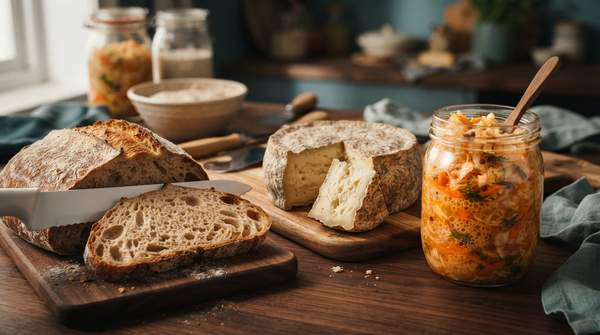
Every slice of tangy sourdough and wedge of sharp cheese owes its character to a quiet biochemical workforce: enzymes. Three classes do most of the heavy lifting in fermentation. Amylases split starch into simple sugars, feeding yeast and softening bread's crumb. Proteases break proteins into peptides and amino acids, deepening savory flavor and tenderizing texture. Lipases hydrolyze fats into fatty acids and glycerol, delivering the rich, sometimes pungent aromas that define cheeses. Understanding these three reactions is the key to understanding why fermented foods taste, feel, and keep the way they do.
The Biochemical Magic of Fermentation
Fermentation is often described as microbes "working their magic," but the real machinery is enzymatic. A review of enzymes in fermented foods notes that microorganisms' activity drives fermentation by changing foods' chemical and physical properties, improving everything from flavor and aroma to safety—and, importantly, giving fermented foods a longer shelf life than their raw ingredients. Cheese is the review's own example: it tastes more interesting than the milk it came from.
Where do the enzymes come from? Two sources dominate. First, the microorganisms themselves: a scientific review of fermented foods states that in these products, proteases are primarily produced by the microbial starters—the yeasts and bacteria that carry out fermentation. Second, food producers add enzymes deliberately to control the process, a practice food-science writers at Amano Enzyme describe as standard across baking, brewing, and dairy production. Fermentation, in other words, is not a spontaneous accident but a managed cascade of enzyme-catalyzed reactions.
Amylases: Sweetness, Softness, and Structure
Starch is a locked pantry of energy—long chains of glucose that yeast cannot directly use. Amylases are the keys. According to Amano Enzyme's research team, amylolytic enzymes break down starch into simpler sugars, and in baking this conversion improves dough handling while enhancing the texture and volume of bread. In brewing, the same reaction supplies yeast with the fermentable sugars that power fermentation.
The flavor payoff is indirect but crucial: the sugars that amylases release become fuel for yeast, which converts them into the compounds that give leavened bread its characteristic taste and rise. The texture payoff is direct. In the bakery, amylases provide a better rise and a softer crumb, according to Amano's account of industrial baking. The same logic applies to a sourdough cracker: the flour's starch must be unlocked before fermentation can begin in earnest.
Proteases: Savory Depths and Tender Textures
Proteases, also called proteolytic enzymes, hydrolyze proteins into smaller peptides and amino acids—a process known as proteolysis. Amano Enzyme lists their benefit bluntly: enhanced flavor and improved texture across dairy, baking, and meat processing. The smaller peptides and amino acids are flavor precursors, the building blocks of the savory depth that makes aged cheese or long-fermented dough taste more complex than its raw ingredients.
The texture effects are just as concrete. A review of enzyme applications in fermented foods reports that as proteins break down into small peptides, the viscosity of the food matrix increases, forming a thicker, creamier texture. The same review highlights chymosin—rennet—as the workhorse of cheese-making: it hydrolyzes κ-casein, causing casein micelles to coagulate and form cheese curds. In bread, protease treatment improves loaf volume by altering batter rheology so the dough retains gas better before baking. And in fermented foods generally, the review notes, these proteases come mostly from the microbial starters themselves.
Lipases: Rich Aromas and Creamy Mouthfeel
Lipases hydrolyze fats and oils, splitting triglycerides into fatty acids and glycerol. Amano Enzyme credits them with flavor development and shelf-life extension in dairy, bakery, and oil-processing applications. The fatty acids released by lipolysis are the signature flavor compounds of many cheeses—rich, sharp, and sometimes decidedly pungent.
This is why the same milk can become mild mozzarella or assertive blue cheese: different lipase activity, different fatty acid profile, different personality. The reaction also contributes to the creamy mouthfeel of high-fat fermented products, as the breakdown of large fat molecules changes how the food flows and coats the palate. Compared with amylases and proteases, lipases act on a smaller share of most recipes' mass—but in fatty foods, their sensory footprint is outsized.
Enzyme Action: Transforming Food Properties
The table below maps each enzyme class to its substrate, its biochemical action, and the observable results in the finished food—use it as a quick reference for which reaction is responsible for which characteristic.
| Enzyme Class | Substrate | Biochemical Action | Impact on Flavor | Impact on Texture | Impact on Shelf Life |
|---|---|---|---|---|---|
| Amylases | Starch | Hydrolyze starch into simpler sugars | Release fermentable sugars that yeast converts into flavor compounds | Improved dough handling, better rise, softer crumb | Contributes to shelf-life extension in baked goods |
| Proteases | Proteins | Hydrolyze proteins into peptides and amino acids | Peptides and amino acids act as flavor precursors, deepening savory notes | Increased viscosity and creaminess; chymosin coagulates casein into curds; improved gas retention and loaf volume | Part of the general preservation effect of fermentation |
| Lipases | Fats and oils | Hydrolyze fats into fatty acids and glycerol | Fatty acids create characteristic rich, sometimes pungent cheese flavors | Contributes to creamy mouthfeel | Credited with shelf-life extension in dairy and bakery applications |
Read across a row and the logic of fermentation appears: one enzyme, one substrate, one cascade of consequences. Amylases explain the soft crumb; proteases explain the savory depth and the curd; lipases explain the pungent aroma. No single enzyme makes a food—each class handles its own macromolecule.
Enzymes and Extended Shelf Life
Shelf life is the least visible but commercially vital outcome. The fermented-foods review states plainly that fermented foods keep longer than the original foods, crediting microbial activity and the resulting chemical and physical changes. Amano Enzyme attributes shelf-life extension specifically to lipases in dairy and bakery contexts, and to enzymes generally in the bakery, where they facilitate leavening, improve texture, and extend shelf life.
The general principle is that enzymatic breakdown, combined with microbial activity, transforms the food matrix in ways that make it less hospitable to spoilage—though the evidence attributes this preservation to fermentation as a whole rather than to any single enzyme class. That is a fair boundary: amylases, proteases, and lipases each shape flavor and texture in well-documented ways, while preservation is a system-level benefit of the fermentation they enable.
Harnessing Enzymes for Fermented Food Innovation
Food producers and home fermenters can strategically influence the characteristics of fermented foods by understanding and managing the activity of natural and added enzymes. The practical lever is substrate and microbe selection: choose a starter rich in proteases and you steer toward savory depth; favor amylase activity and you steer toward softness and rise; encourage lipolysis in a fatty matrix and you steer toward pungent aroma. The measurable indicator of success is the consistent achievement of desired flavor profiles, textures, and shelf life in fermented products—outcomes you can taste, feel, and observe batch after batch.