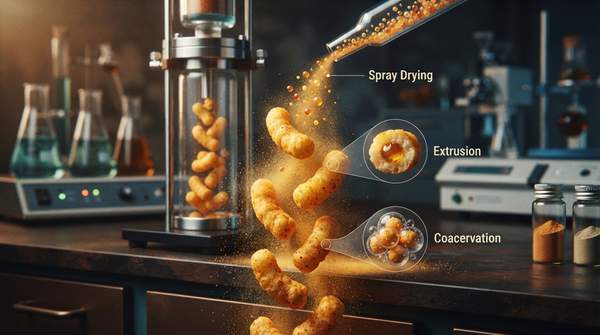
Ever wonder why a cheese cracker still tastes like cheese after a trip through a 400°F oven, or why a stick of gum keeps delivering flavor long after the first chew? The answer, more often than not, is flavor encapsulation: the practice of wrapping delicate flavor compounds inside a protective carrier so they survive processing, storage, and handling—and then release at exactly the right moment. As food technologist Mike Porzio wrote in the Institute of Food Technologists' magazine, manufacturers have evaluated a long menu of encapsulation approaches, but only a few—spray drying, melt extrusion, and complex coacervation among them—have made it into widespread commercial use. Here is how those three work, and why a snack maker picks one over another.
Two Jobs Every Capsule Has to Do
Before the technology, the "why." Encapsulation exists to solve two intertwined problems. The first is protection: many flavor compounds are volatile and fragile, vulnerable to heat, oxidation, and moisture long before a snack ever reaches a shopper's basket. The second is control. As Thermo Fisher's food-science writers explain, the carrier matrix surrounding a flavor determines its stability, taste perception, and release profile—meaning the capsule isn't just armor, it's a timed delivery system. A manufacturer designing a baked cracker wants the flavor locked in during baking and released when a customer bites down. A gum maker wants a slow, sustained release over minutes of chewing. Same goal—flavor that arrives on cue—achieved through very different engineering.
Melt Extrusion: Robust Protection for High-Temperature Processing
Melt extrusion is the heavyweight champion of harsh conditions. In twin-screw extrusion, a continuous process that combines thermal and mechanical energy, the carrier matrix—typically a carbohydrate or other meltable material—is heated until it softens, then mixed thoroughly with the dispersed flavor phase. The flavored melt is pushed through a die and shaped into pellets, flakes, or other structured forms, trapping the flavor inside as the matrix cools and solidifies.
What makes extrusion special is the sheer robustness of that solid matrix. Because the flavor is embedded deep within a continuous glassy material rather than sitting near a particle's surface, it enjoys excellent protection against oxidation and heat degradation—precisely the insults a snack suffers during baking or frying. That's why extrusion suits baked goods, fried snacks, and confectionery, where a seasoning would otherwise flash off or scorch in the oven or fryer.
There's a practical bonus, too. Thermo Fisher's writers note that while spray drying typically produces fine powders, extrusion enables larger, structured particles and more complex dosage forms. That matters when a manufacturer needs a capsule that won't dust off a snack surface, or needs a specific particle geometry to survive mixing and handling on a production line. The trade-off is that extrusion demands equipment and process control beyond a simple dryer, and the flavor must tolerate the heat of the molten matrix during the run itself.
Complex Coacervation: Precision for Controlled Flavor Release
If extrusion is a fortress, complex coacervation is a smart lock. The technique, described in a comparative review of flavour encapsulation published in the scientific literature, is a nano- and microencapsulation method that uses phase separation in a polymeric dispersion—triggered by a specific condition such as pH adjustment or a temperature change—to produce a liquid, polymer-rich phase called a coacervate. In plain terms: you start with an emulsion of flavor droplets suspended in a solution containing two oppositely charged polymers. Nudge the conditions, and the polymers separate out of solution and precipitate around each flavor droplet, forming a thin, tailored shell.
That shell is the whole point. Because the wall composition and thickness can be engineered, coacervation offers controlled release properties triggered by specific environmental factors—moisture, pH shifts, or enzymatic activity. A capsule can be built to stay inert on the shelf and then rupture or dissolve only when it meets saliva and the mechanical action of chewing.
This is the mechanism behind long-lasting flavor in products where release timing is the entire sensory experience. Chewing gum is the classic case: a flavor that releases gradually under the pH and enzymatic conditions of the mouth keeps tasting good chew after chew. One honest caveat—the sources here describe the release mechanism itself rather than naming gum explicitly, so treat that application as a well-grounded inference from the technology's characteristics rather than a cited product example. The cost of all this precision is complexity: coacervation requires careful control of polymer chemistry and processing conditions, making it more involved than simply drying a flavored slurry.
Comparative Overview of Flavor Encapsulation Technologies
| Technology | Core Mechanism | Primary Benefit | Ideal Snack Application |
|---|---|---|---|
| Spray Drying | A liquid flavor emulsion or dispersion is atomized and dried into a solid powder form | Converts liquid flavors into stable, handleable fine powders | Fine powders such as powdered drink mixes and dry seasoning blends |
| Melt Extrusion | Flavor is mixed into a molten carrier matrix and extruded through a die, trapping the flavor as it cools into pellets or flakes | Excellent protection against oxidation and heat degradation; enables larger, structured particles | Baked goods, fried snacks, and confectionery that undergo high-temperature processing |
| Complex Coacervation | Controlled phase separation—via pH adjustment or temperature change—precipitates a polymer-rich coacervate around flavor droplets | Precise, trigger-based controlled release (moisture, pH, enzymatic activity) | Products needing sustained or triggered release, such as long-lasting chewing gum (inferred from release mechanism) |
Read across the rows and the pattern is clear: each technology answers a different question. Spray drying asks, "How do I turn this liquid flavor into something I can ship and blend?" Extrusion asks, "How do I get flavor through an oven or fryer alive?" Coacervation asks, "How do I make flavor appear exactly when the consumer experiences the product?" No single method wins; each dominates its own problem space.
Choosing the Right Technique for Your Snack Product
So how does a manufacturer actually decide? Start with the two questions that encapsulation itself is built around. First, what will the flavor have to survive? If the answer is a bake, a fry, or months in a bag exposed to oxygen, the deep entrapment of melt extrusion offers the strongest shield. If the flavor merely needs to exist as a manageable dry ingredient, spray drying—the workhorse that converts liquid flavor systems into fine powders for drink mixes and seasoning blends—is the straightforward route.
Second, when should the flavor arrive? If the goal is a burst of flavor the instant a snack hits the tongue, a readily soluble spray-dried powder releases quickly on contact with moisture. If the goal is endurance—flavor that keeps going through a long chew or a slow dissolve—coacervation's engineered, trigger-responsive shells are the precision instrument, releasing their cargo in response to moisture, pH, or enzymes rather than all at once.
Practical constraints shape the final call as well. Extrusion's structured pellets and flakes behave differently in mixing and handling than a fine spray-dried powder, and coacervation's multi-step polymer chemistry demands more process sophistication than either. Porzio's survey of the field makes the broader point: many encapsulation approaches have been evaluated, but commercial systems cluster around the few methods that reliably balance performance with manufacturability.
Strategic Selection for Enhanced Snack Flavor
Manufacturers should select a flavor encapsulation technique based on the specific processing conditions of the snack (e.g., high heat) and the desired flavor release profile (e.g., immediate burst, prolonged release, or triggered release). The way to know whether the choice was right is measurable: the stability of flavor during processing and storage, and the sensory experience upon consumption (e.g., flavor intensity, duration, and timing of release). A capsule that keeps a baked cracker aromatic after its oven ride, or a gum flavorful ten chews in, has done its job—and that is exactly what the evidence says these three technologies are engineered to deliver.