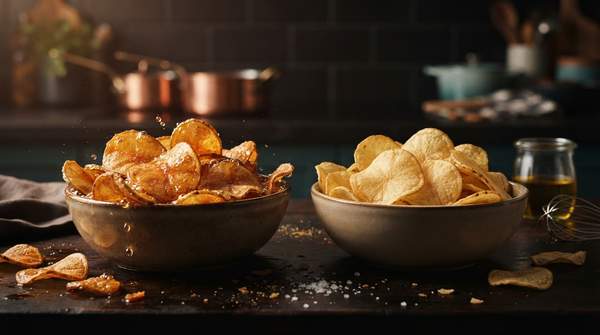
Deep-frying and air-frying both promise golden, crispy starchy snacks, but they get there by fundamentally different routes—and the route determines the crust, the interior, the flavor, and the fat. Deep-frying transfers heat by immersing food in hot oil, a process that produces thick crusts, dramatic expansion, and oil-infused flavor. Air-frying transfers heat with high-velocity circulating hot air, dehydrating the surface rapidly and delivering crispness with a fraction of the oil. Understanding the physics and chemistry behind each method lets you predict exactly what your potato snack will become before you commit.
The Science of Snack Frying: Deep-Frying vs. Air-Frying
The two methods differ at the level of the heat transfer medium itself. In conventional immersion frying, the food is submerged in oil at high temperature, and heat moves into the food through direct contact with the liquid. A comparative study of potatoes published in PMC describes this as a process involving complex heat and mass transfer phenomena, where the oil simultaneously cooks the surface and interacts with the water inside the food. Air-frying, by contrast, surrounds the food with superheated, rapidly circulating air, using sometimes as little as a teaspoon of oil, according to enthusiast coverage of air fryer technology on Webb Networth. That difference in medium—liquid versus gas—cascades into every sensory outcome that follows.
Heat Transfer and Moisture Dynamics: The Foundation of Texture
Water is the hidden protagonist in both methods. The potato study found significant differences in weight loss between the two frying techniques: immersion frying did not remove as much water from the samples, which the researchers attributed to the specific heat and mass transfer phenomena of submersion in oil. Oil frying creates thicker crusts, and those crusts in turn affect how water migrates from the interior to the exterior of the food. Air-frying, meanwhile, causes a higher percentage of weight loss because water evaporates more efficiently from the surface, and that rapid surface dehydration is precisely what contributes to a crispy texture. In practical terms, deep-frying tends to lock moisture in behind a substantial crust, while air-frying dries the surface aggressively while the interior steams.