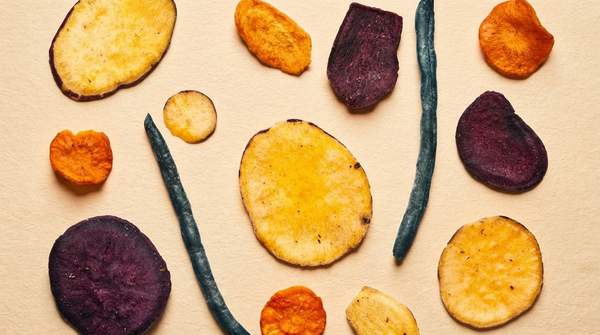
Here's the short version: an upcycled vegetable snack is one made from food that would otherwise have been wasted — not spoiled food, but the "totally-fine excess" of our food system. Think of the pulp left after carrots are juiced, the spent grains from brewing beer, or the crooked squash a farmer can't sell. The category is growing for a straightforward reason: food waste is a genuine climate problem, with the United Nations estimating that food waste in landfill emits 8–10% of global greenhouse gases, and a study published in Nature Food attributing roughly half of the entire global food system's emissions to food loss and waste. Once you know what to look for, most upcycled vegetable snacks fall into one of two strategies.
Strategy 1: Repurposing Processing Byproducts
This is the quieter of the two approaches, and honestly, the more food-scientist-y one. Instead of starting with a whole vegetable, these brands start with the leftovers of another food manufacturing process and turn them into something you'd actually want to eat.
Josh Death, founder of Kazoo Snacks, described the approach to The Food Institute: "We've sourced a by-product of the corn starch industry, just as Regrained sourced spent brewer grains and Pulp Pantry vegetable peelings." Kazoo makes chips and cheese powder from corn germ; Regrained has turned brewing leftovers into its SuperGrain+ ingredient; Pulp Pantry works with the vegetable pulp that juicing would otherwise discard. Death is candid that sourcing the waste stream is the easy part: "The real challenge is formulating such upcycled ingredients into a great tasting product."
One thing worth knowing: the specific handling and formulation processes are proprietary to each brand, so two "upcycled" chips can be made quite differently. And the byproduct route wasn't always planned — Kazoo's use of corn starch industry waste came about through an unintentional discovery by the developer rather than a top-down sustainability strategy.
Strategy 2: Rescuing Imperfect or Surplus Produce
The second strategy starts earlier in the supply chain: whole fruits and vegetables that are cosmetically imperfect, surplus, or simply unwanted at markets and farms — produce that's still perfectly fit for consumption but has nowhere else to go.
Sophie Hares, writing for Mastercard's newsroom, profiles one such entrepreneur: Chan, who had worked in restaurant kitchens while in school, began "spending her evenings experimenting with produce salvaged from the market to find ways to upcycle the fruits and greens farmers worked so hard to grow." Her cold-pressed juices and energy balls drew buyers at the market, and in 2019 she turned the effort into her snack business, Bruized. It's a reminder that this strategy is often scrappy and entrepreneurial — one person, one commercial kitchen, one crate of unsold greens at a time.
Comparing Upcycled Vegetable Snack Strategies
Here's the framework I use to sort any upcycled snack I see on a shelf. Fair warning: this categorization is my synthesis of the examples in the reporting, not a formally defined industry standard — brands don't announce which "strategy" they belong to.
| Upcycling Strategy | Waste Stream Source | Example Product Type |
|---|---|---|
| Processing byproducts | By-products of other food manufacturing — e.g., corn germ from the corn starch industry (Kazoo) | Chips and cheese powder made from corn germ |
| Processing byproducts | Spent brewer's grains from beer brewing (Regrained's SuperGrain+) | Grain-based snack ingredients for various products |
| Processing byproducts | Vegetable peelings and pulp discarded from juicing (Pulp Pantry) | Veggie-based snacks made from rescued pulp |
| Imperfect/surplus produce | Whole produce salvaged from markets and farms — unwanted but fit for consumption | Cold-pressed juices and energy balls (Bruized) |
The practical payoff of the table: when a package says "upcycled," you can ask one question — is this rescuing a manufacturing leftover, or rescuing a whole vegetable nobody would buy? The answer tells you a lot about the supply chain behind your snack.
Beyond the Label: Factors Influencing Sustainability and Cost
Now the plot twist: "upcycled" doesn't automatically mean sustainable, and it doesn't automatically mean viable. A briefing from New Zealand's Public Health Communication Centre is blunt about the economics: the financial viability of individual upcycled foods varies depending on the research and development required, the cost of ensuring the by-product is fit for purpose, and current waste disposal costs. Sustainability also requires a reliable supply of the upcycled ingredient and the economies of scale that larger organizations achieve.
Price cuts both ways, too. Consumers are willing to pay more for upcycled food with clear nutritional and environmental labelling — but, as the same briefing notes, higher prices for environmentally sustainable products can reduce sales and product expansion, and if consumers are unwilling or unable to pay, upcycling food becomes an unviable option. Karthik Sajith Babu and Kartik Shah, writing in Food Technology Magazine, add a wrinkle: a high price can discourage purchase, yet it can also signal quality and boost demand — so consumer perception and marketing communication do a lot of the heavy lifting.
There's also a bigger-picture caution. The briefing flags that more sustainable and equitable uses for surplus food may be overlooked if the social impacts of upcycled food aren't considered, and that the industry may in some situations have an unintended negative impact on food security. The environmental case for a given snack depends on its specific context and on what else the diverted material could have been used for.
Making Informed Choices About Upcycled Snacks
So here's my honest decision framework, built from everything above: consumers should evaluate upcycled snacks by considering both the source of the upcycled ingredient and the overall processing, cost, and alternative uses of the diverted material. A chip made from juice pulp and a juice made from unsold market greens are both "upcycled," but they rescue different waste streams and face different economics.
The measurable indicator to look for is clear labeling that names the specific upcycled ingredient and its origin, alongside transparent pricing. If a package can tell you what was rescued and from where, you can place it in the framework yourself — and judge whether the premium you're paying reflects real diversion of waste. And to be upfront about limits: the sources here don't provide brand-by-brand environmental figures like water saved or CO2 reduced, so treat those numbers skeptically until you see how they're calculated.